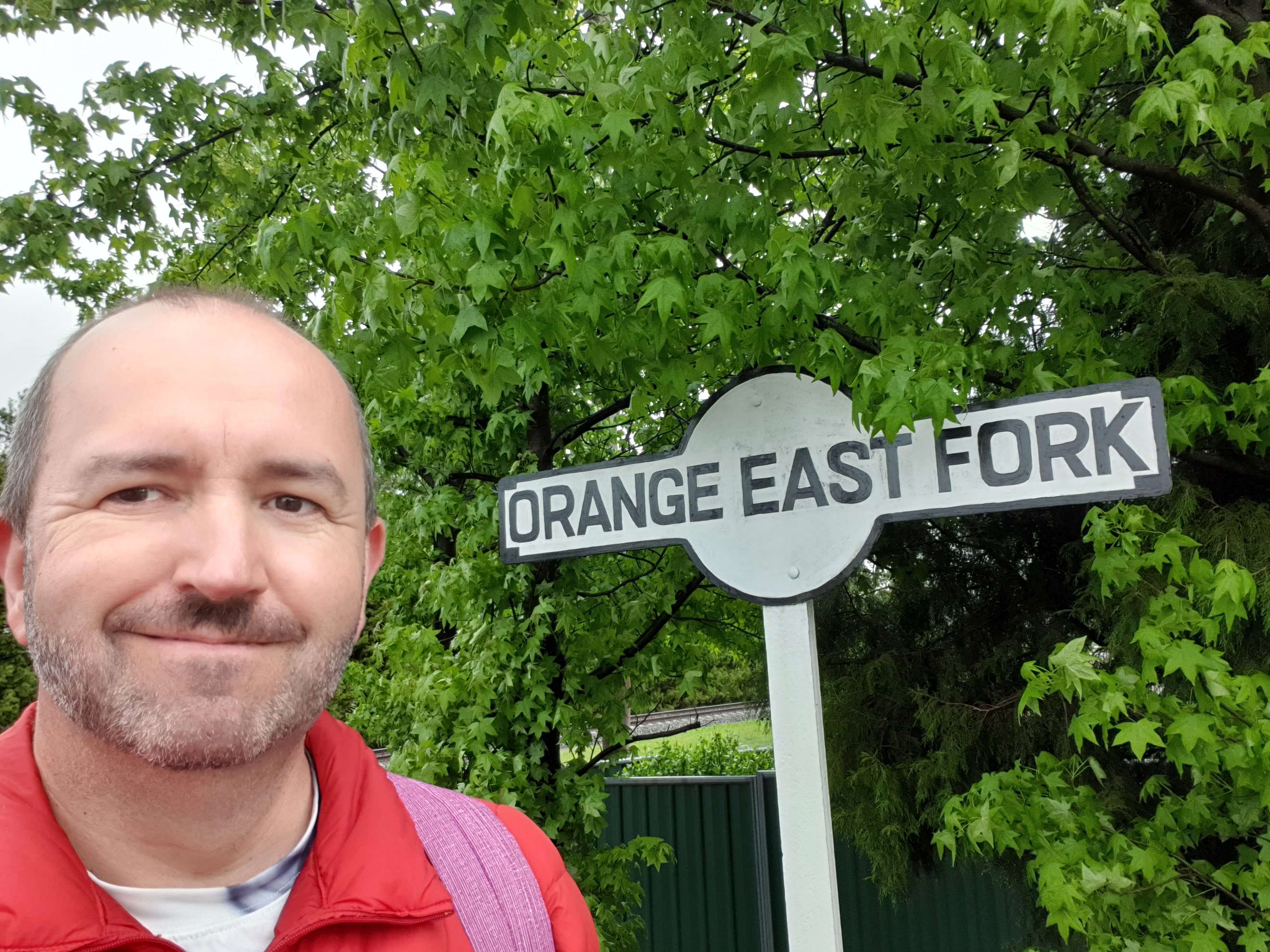


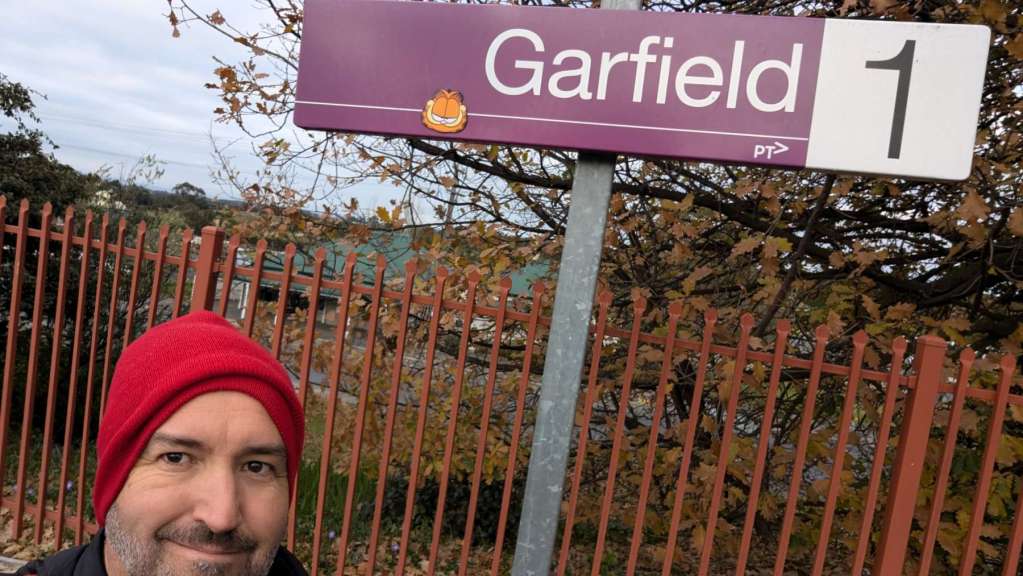
Garfield is an unstaffed railway station on Victoria’s Gippsland line, located some 75 kilometres east of Southern Cross. Obviously it wasn’t actually named after the well-known cartoon cat.
Equally obviously, I had no choice but to visit the station wearing a Garfield T-shirt and attempt a little rebranding.

But where does the name originate from? The standard story, repeated on Wikipedia and elsewhere, is that the small township of Garfield (and hence the station) took the name from US president James A. Garfield. But the truth is a little more murky.
The original station opened on 17 April 1884, with the name Cannibal Creek Siding. The line already ran through the area, but growing agricultural activity made a stopping point desirable.
Why was the area called Cannibal Creek? The evidence is mixed. An obvious assumption would be that the reference to cannibalism was a derogatory reference to the local Indigenous population. That wasn’t uncommon in Australia (or elsewhere) in the 1800s.
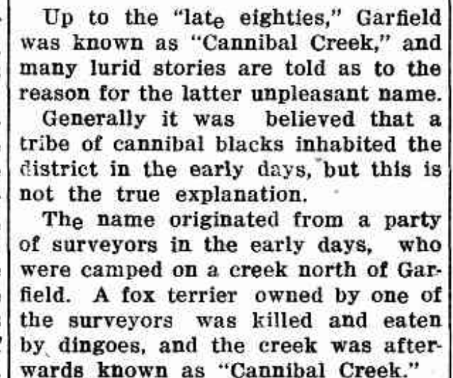
A newspaper item about the town name that ran in the South Bourke and Mornington Journal in 1926 was predictably not keen on that explanation:
Up to the “late eighties”, Garfield was known as “Cannibal Creek,” and many lurid stories are told as to the reason for the latter unpleasant name. Generally it was believed that a tribe of cannibal blacks inhabited the district in the early days,’ but this is not the true explanation.
The paper held that the name referred not to the indigenous population, but to dingoes:
The name originated from a party of surveyors in the early days, who
were camped on a creek north of Garfield. A fox terrier owned by one of
the surveyors was killed and eaten by dingoes, and the creek was afterwards known as “Cannibal Creek.”
That might not be true either (note there’s no date or source for the claim).
Another possibility: The original station leased in the area was called Connabul Creek Run, a name which may have come from the local Indigenous population’s name for the nearby mountain.
It’s easy to see how that spelling might have evolved into “cannibal” relatively quickly. As with many place names, there’s a lack of unambiguous contemporary evidence.
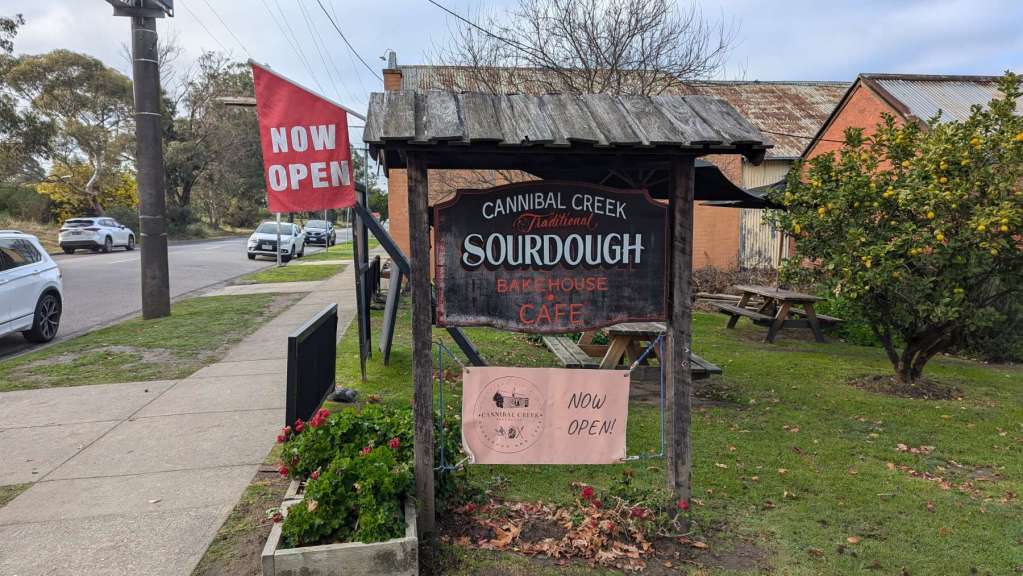
The waterway that runs through the area is still called Cannibal Creek, and there’s a local bakery in Garfield using the name, and also a winery.
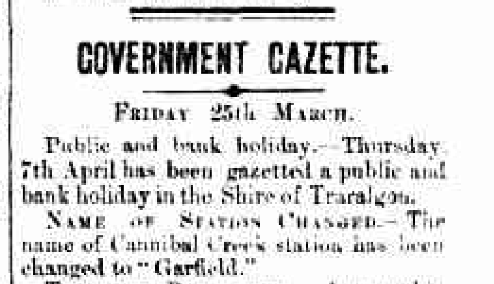
Regardless, Cannibal Creek was renamed Garfield on 25 March 1887, according to government gazette documents reported in local papers:
The Melbourne Argus reported in its list of post office notices May 1887 that from 10 May, mail addressed to the station must henceforth refer to Garfield, not Cannibal Creek.
But why honour Garfield (if that was the intention) some 6 years after his assassination? He had no obvious connections to Australia (unlike one of his presidential successors, Herbert Hoover, who worked as a mining engineer in Western Australia for 3 years). Having served as president for only 6 months, he also had little opportunity to influence US politics, let alone Australian place names.
Contemporary newspapers don’t shed much light on that matter. There’s no unambiguous reportage giving the presidential connection as the source of the name that I could find. But investigations reveal that Garfield was not the first choice of name for the township.
Our chief evidence for this comes from a report in the South Bourke and Mornington Journal of 9 February 1877 of correspondence received by Berwick Shire Council, which included Cannibal Creek:

The first crucial item was a letter from the Railway Department, saying that “the name of Cannibal Creek cannot be altered to Hope Town, as suggested, as there is already a postal town of that name in the colony”. So Hope Town was the original preferred choice for the locals, but didn’t fly.
(Side note: Some historians claim that the intended name was Hopetoun, not Hope Town as we see in this report. While it’s easy to imagine that kind of typo hitting the papers, Hopetoun in Victoria wasn’t established until 1891, so it seems unlikely to have been the source of the clash. There’s a Hopetoun in Western Australia too but that name comes even later, in 1900. That said, it’s not immediately obvious which existing settlement was the reason for not allowing the name “Hope Town” either – though it may just have been to avoid confusion with Hopetown in South Africa.)
Anyway, the settlers were already adapting to the rejection. The council also received a letter from Hugh Paul of Cannibal Creek, reporting the outcome of a public meeting in the township the previous month.
The following names were agreed to, the first to be selected if eligible, if not the second, and so on in rotation — Mount View, Gladstone, Garfield, Kenilworth, Soho. — The list of proposed names to be forwarded to the Railway Department.
Hence Garfield was choice number 4. It’s not surprising the other preferred alternatives didn’t fly. Mount View in NSW’s Hunter Valley was already established, in one of Australia’s densest railway districts.
Gladstone was just as unlikely. Gladstone, Queensland was settled as a township in 1863, and there were already smaller rival Gladstones located in Tasmania and Victoria.
So Garfield it was – but clearly honouring a US president was not the top priority for Gippsland locals at the time. And it might not have been the intention at all. As that South Bourke and Mornington Journal 1926 item on the name of the town concluded:
Once upon a time a man named Garfield was president of the United States of America, but whether this particular Garfield was named after him or not has not been disclosed.
Almost 100 years later, the answer’s not any clearer.

For more deep dives into railway history, check out the stories of Orange East Fork and Cootamundra West.
Leave a Reply