
Ruth Rendell published 14 novels under the pseudonym Barbara Vine between 1986 and 2012. Why did she do that? The answer: a mixture of experimentation and pragmatism.
Ruth Rendell generally resisted the suggestion that there was a major gap between the works published in her name and those under the name Barbara Vine. In an interview with radical magazine Red Pepper in 1997, she commented:
I never kept the fact that I was Barbara Vine a secret. It was just a way of doing a different kind of book. The characters are deeper and they feature not so much murder as accidental death or societal pressures. I thought it would be a minor strand, but they’ve turned out to be as popular as my other books.
In 1997, the Penguin Web site explained the difference as follows: “She wanted to write a different kind of psychological thriller, and distinguish these books by using a different name, whilst at the same time making clear her real identity.” The introduction to the abridged edition of The House Of Stairs is rather more pragmatic, but echoes the same theme: “She used a different name because she wanted to write in a different way.”
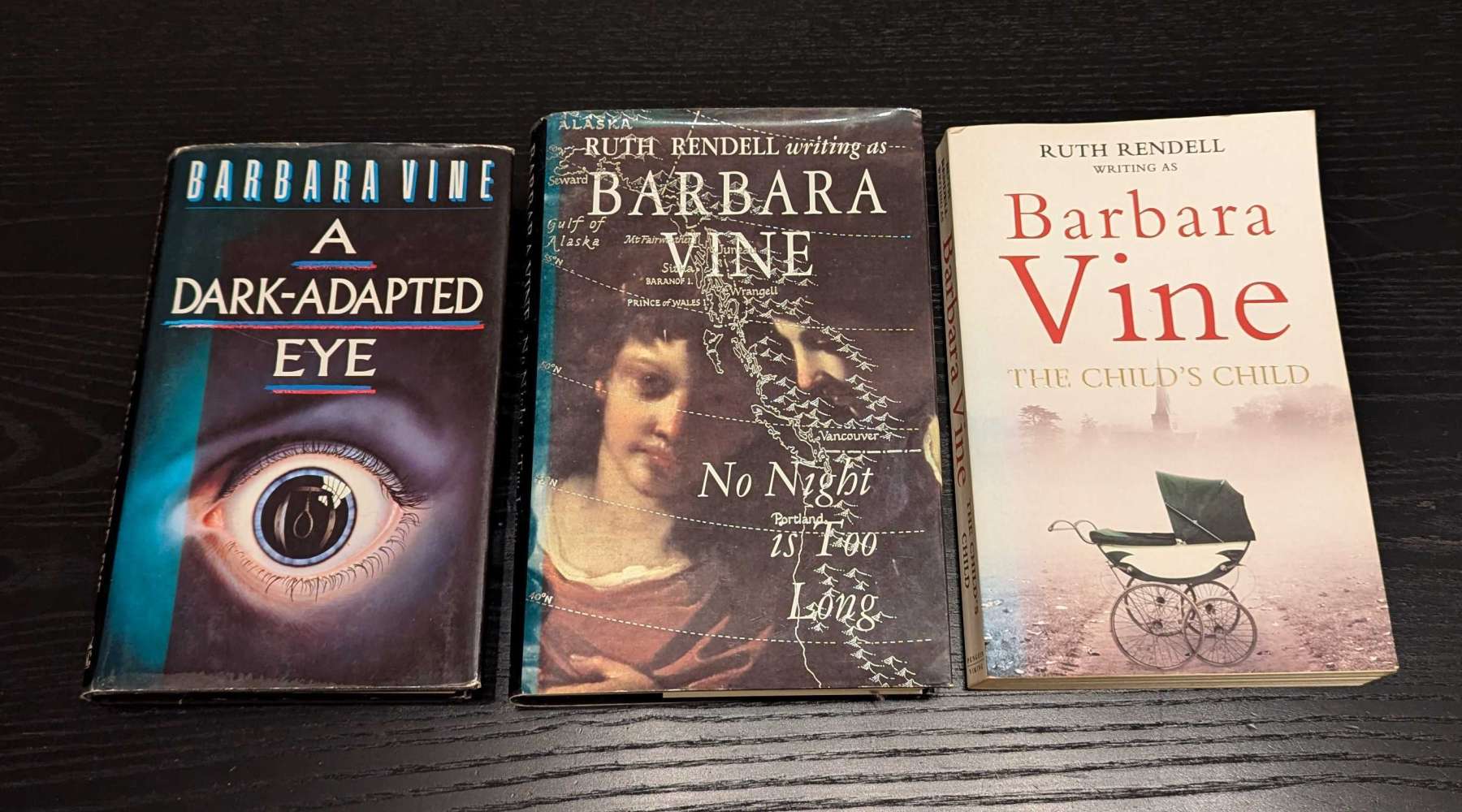
Certainly no attempt was made to conceal the dual identity. The first Vine novels displayed both names on the cover; some more recent editions have removed such references, but this could be a reflection of the fact that the Vine name became clearly established with the reading public.
In the first US paperback editions of A Dark Adapted Eye and A Fatal Inversion, Rendell provided an introduction which was perhaps the most comprehensive explanation of her dual identities (thanks to the late Philip Swan who originally typed this up):
There is nothing unusual in having two Christian names, but perhaps it is less common to be called by each of them equally. This is what happened to me. Ruth was my father’s choice of name for me, Barbara my mother’s. Because Ruth was difficult for my mother’s Scandinavian parents to pronounce, her side of the family called me Barbara, and since this sort of duality was impossible in one household, my father finally started calling me Barbara too.
I tend to divide friends and relatives into the “Ruth people” and the “Barbara people”. Both names are equally familiar to me, equally “my” names. If either were called out in the street I would turn around. And I don’t mind which I am called so long as people don’t try to change in, so to speak, midstream.
There is for me something grotesque in a Barbara person trying to become a Ruth person, or vice-versa. Only my husband knows as well as I do into which category each friend falls. He can write the Christmas cards and always get them right. But he never calls me by either of my Christian names.
It has always interested me—I don’t think my parents realized this—that both my names mean or imply “a stranger in a strange land.” Ruth who was exiled into an alien country, Barbara that signifies “a foreigner.”
Growing up with two names doesn’t make you into two people. It does give you two aspects of personality, and Ruth and Barbara are two aspects of me. Ruth is tougher, colder, more analytical, possibly more aggressive. Ruth has written all the novels, created Chief Inspector Wexford. Ruth is the professional writer. Barbara is more feminine. It is Barbara who sews. If Barbara writes it is letters that she writes.
For a long time I have wanted Barbara to have a voice as well as Ruth. It would be a softer voice speaking at a slower pace, more sensitive perhaps, and more intuitive. In A Dark-Adapted Eye and A Fatal Inversion she has found that voice, taking a surname from the other side of the family, the paternal side, for Vine was my great-grandmother’s maiden name. There would be nothing surprising to a psychologist in Barbara’s choosing, as she asserts herself, to address readers in the first person.
I hope you will enjoy reading these books, as much as Barbara Vine enjoyed reading them.
One factor in the decision which hasn’t been extensively discussed is the notion that Rendell was looking for a second publisher. All her work under her own name was published by Hutchinson/Arrow, while the Vine books were Viking/Penguin productions.
Such a decision could have been made on pragmatic grounds alone. Especially considering the quality of her work, Rendell was an unusually prolific writer; at one stage in the 1980s she was producing close to three full-length novels a year, plus a similar number of short stories.
Although back catalogue sales are always welcome, publishers often seek to dissuade authors from producing new titles too frequently, both because flooding the market is not the best way to maximise the sales of an existing successful title and also because literary critics don’t tend to respond favourably to “too high” a rate of production. Taking on a different identity would help ease both problems.
This theory is indirectly supported by the fact that the sole Barbara Vine short story in existence, ‘In The Time Of His Prosperity’, was originally part of a Penguin tribute volume. Short stories under Rendell’s name have appeared initially with many publishers, although most have ended up in Hutchinson anthologies. (‘In The Time Of His Prosperity’ did eventually appear in Rendell’s posthumous short story collection A Spot Of Folly).
Unlike, say, Agatha Christie, who published six romantic novels under the name ‘Mary Westmacott’ that varied dramatically from her normal murder mysteries, the Barbara Vine titles are not so dissimilar from Rendell’s non-Wexford work (and even some of the later Wexford titles) that a change in identity would require a change of name. Indeed, later in her working life, reviews commented that Rendell’s style appears to be coming closer to that of Vine.
The Vine books do maintain certain thematic commonalities (the relationships between families, delving back into the past) which set them apart from the larger body of Rendell work. Rendell herself also sometimes appears to treat them as a quite separate body of work. This is most obvious in the dedication of A Fatal Inversion, which reads in part “with love from Barbara”.
Rendell seemed to find the continuing interest in her dual identity a little tedious. As she told Nick Rennison in 1997: “Other writers have pseudonyms. Lots of other writers. So, why not me?”
For more on Rendell’s “other woman”, check out which Barbara Vine titles are available on Kindle.
Leave a Reply