

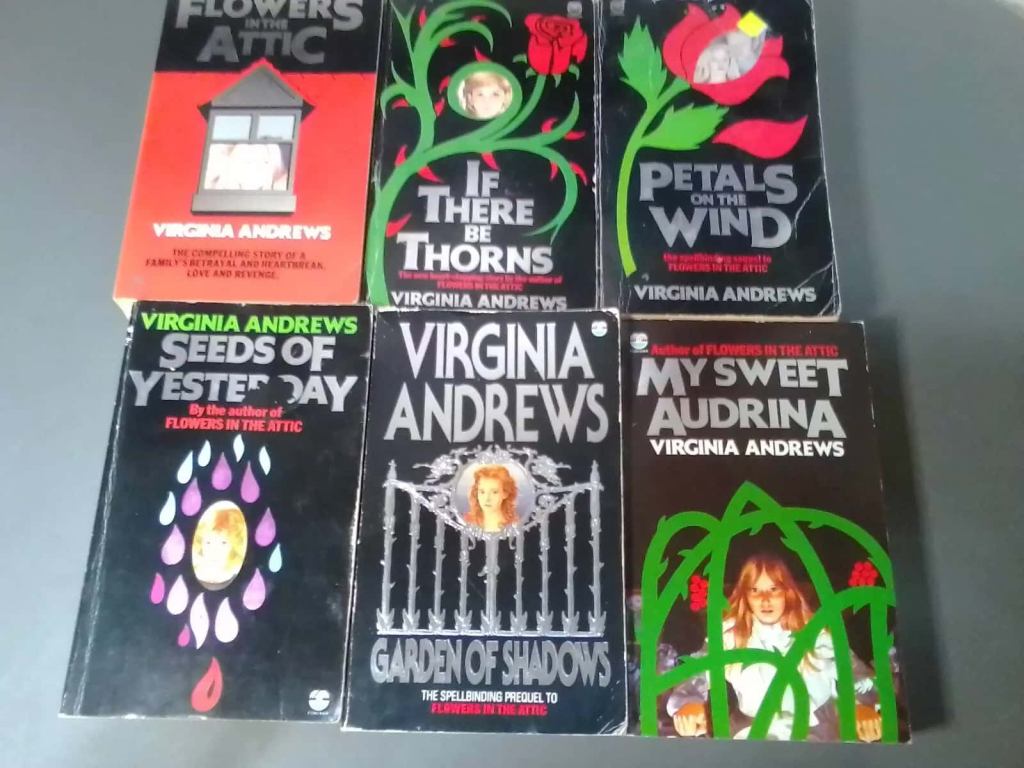
I’ve long had a fascination with V.C. Andrews, the infamous author of Flowers In The Attic and other tawdry paperback tales of teenage lust, incest and general family nastiness. That springs a little from her ubiquity during my teenage years, when those distinctive die-cut covers could be seen falling from many a school satchel. But it’s largely because of the massive con job associated with her publishing career.
When Virginia Andrews died of cancer in 1986, seven of her books had been published. (In Australia, as in the UK, these appeared as “Virginia Andrews”, not the “V.C. Andrews” gender-blurring nom de plume used in the US.) Yet as I write this, there are more than 90 Andrews titles.
The vast majority of those books were written by ghost writer Andrew Neiderman. Neiderman’s role was initially kept secret, but was completely exposed after the IRS successfully launched a legal case arguing that Andrews’ name should be included for tax purposes in the value of her estate.
This is the sleight of hand which her publishers initially explained the ghost writing away with:
When Virginia became seriously ill while writing the Casteel series, she began to work even harder, hoping to finish as many stories as possible so that her fans could one day share them. Just before she died we promised ourselves that we would take all of these wonderful stories and make them available to her readers.
The sheer chutzpah of that claim has always intrigued me.
Anyway, I’ve been belatedly reading The Woman Beyond the Attic: The V.C. Andrews Story, the 2022 family-sanctioned biography. Perhaps unsurprisingly, it’s also written by our productive ghost writer friend Neiderman. According to his introduction, 107 million Andrews books have sold so far – 81 million of those since Andrews’ death.
While Neiderman had access to the family archives, including numerous letters written by Andrews, I’m not convinced that we learn much more from his volume than we did from the IRS court judgement. There’s an awful lot of time invested in the question of what we can learn about Virginia’s character from Flowers In The Attic, and less than I’d expect on the actual progress of her writing career.
With that said, one detail did immediately jump out at me – this gushing discussion of how productive Virginia was in the last few years of her life:
The time bomb of her cancer was ticking away, but Virginia would go on with the first two books of the Casteel family series, Heaven and Dark Angel, and then her fantasy, so different from everything else she had published, Gods of Green Mountain, her only published sci-fi novel, about a planet with two blazing suns.
This phrasing (“and then” in particular) suggests that her sci-fi novel, the ponderously-titled Gods Of Green Mountain, was completed during the very last years of Andrews’ life. Huh?
My previous reading on Andrews had suggested that Gods Of Green Mountain was a much earlier production, and that it hadn’t been published because sci-fi was so far from what readers had come to expect from the V.C. Andrews brand (whining teenagers, children in jeopardy, Victorian houses, implausible dialogue, mild raunchiness). What was the truth?
Here’s what we know. The initial source of information about this title for most Andrews fans was the 1985 interview she gave to Douglas Winters for his book Faces Of Fear: Encounters With The Creators Of Modern Horror.
This has long been recognised as the most revealing interview of Andrews’ career (she had an aversion to talking to journalists fuelled by an early interview with People). Indeed, Neiderman quotes extensively from Winters in his biography, and even interviews Winters about the experience to help pad out the text.
Anyway, according to Winters:
In 1972, while living in Apache Junction, Arizona, Andrews began to devote all of her time to writing, completing her first novel, a science fantasy entitled The Gods of the Green Mountain.
That early completion date has been confirmed by Ann Patty, who was Virginia’s editor at Pocket Books. In a 2014 interview, she recalled:
When I met Virginia, she had two other novels I knew of. One was Gods of Green Mountain, which was science fiction and was finally published by Pocket as an ebook a few years ago.
Given Patty signed Virginia in 1979, the novel was clearly complete (if not edited professionally) by that date.
The sci-fi schlock pops up again later in the Winters interview, with a claim that it will be published soon:
In 1986, the first novel that she ever wrote, The Gods of the Green Mountain, will be published after substantial revisions; it will be a major departure for her, a fantasy trilogy aimed primarily at the young adult market.
This never happened, and the IRS case suggests that it was never going to happen in Andrews’ lifetime. The judgement describes the situation more bluntly:
Andrews also submitted to Pocket Books two other manuscripts entitled “Gods Of Green Mountain” and “All The Gallant Snowflakes” which deviated from the “children in jeopardy” genre. Both were rejected.
So any publication plans presumably didn’t stick. Nonetheless, those “substantial revisions” planned for 1986 are presumably what Neiderman is alluding to – but it’s deceptive to present them the way he does.
As Patty pointed out, Gods Of Green Mountain was eventually issued as an ebook in 2004. That late date clearly signals that the estate continued to think there was more to be made from books written in the expected Andrews “style” than something actually written by the author herself.
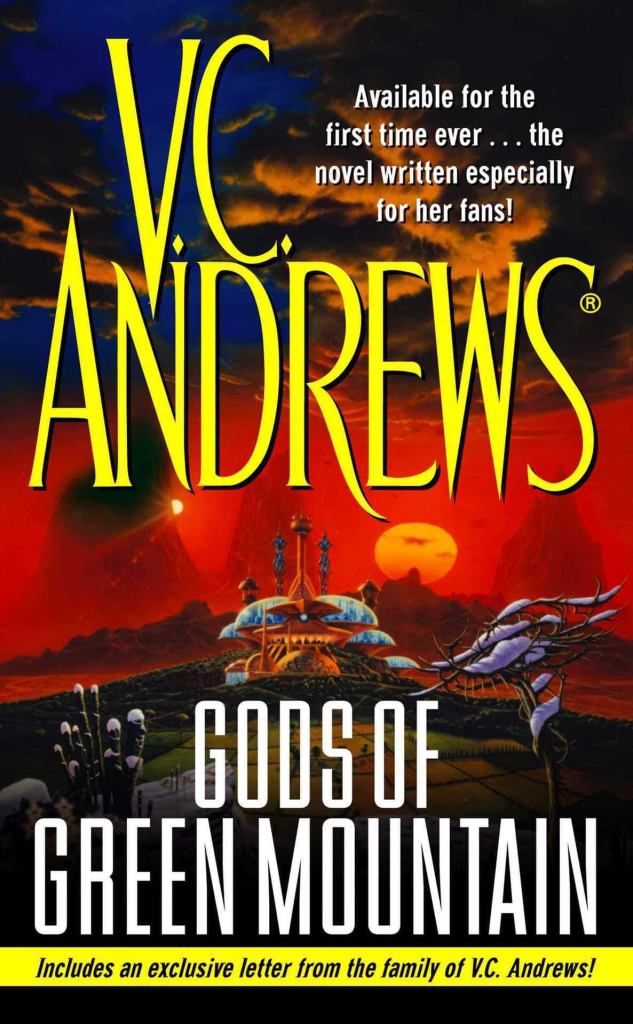
Unsurprisingly, Andrews’ publishers Pocket Books/Simon & Schuster also seemed happy to go along with muddying the waters about the book’s origins when it did emerge. The cover art for Gods Of Green Mountain boldly proclaims that it’s “available for the first time ever . . . the novel written especially for her fans!”
GIven Andrews had no fans when she wrote the book, the publishers had sat on it for 18 years and it has nothing in common with her most famous works, that’s another serious dose of chutzpah.
The ebook edition also “includes an exclusive letter from the family of V.C. Andrews”, which shows that the estate remains happy to blur the lines of fantasy and reality in publishing:
Virginia Cleo Andrews, known to you as V.C. Andrews, died in December 1986. Among the many story ideas, completed manuscripts, and outlines was one of her most favorite, called Gods of Green Mountain . . . Our sister believed so strongly in this manuscript that she elicited our solemn promise that we would endeavor to see that Gods of Green Mountain would be published.
That promise took a couple of decades to keep, it seems.
Anyway, there you have it. Virginia Andrews wrote her lone sci-fi novel in 1972, not late in her life. It may have been lightly edited in 1986, but her publishers have never seen fit to issue it as a print title. It’s a small footnote in her career, but as always, I like the details to be right.
For more literary fact-checking, check out why Enid Blyton wrote under the name Mary Pollock and why Ruth Rendell became Barbara Vine.
Andrews’ publicity photograph by Thomas Van Cleave. Book covers image from eBay.

Leave a Reply