


I’m a major 1980s pop fan/tragic, but stuff can still surprise me. Until today, I’d never heard Lydia Murdock’s ‘Superstar’, when it popped up on the compilation Now 12″ 80s: 1983 (Part One), which I added to my CD collection during my recent UK trip.
The song reached #14 in the UK during a 10-week chart run in late 1983, but never scored an Australian release, which is likely why I hadn’t encountered it before.
‘Superstar’ belongs in the close-to-novelty genre of the answer song, where an opportunistic songwriter writes a “reply” to a popular hit. Lesley Gore’s ‘Judy’s Turn To Cry’, which continues the tale of teen romance/betrayal/horniness started in ‘It’s My Party’, is a classic example.
More recent pop fans might recall Frankee’s ‘F.U.R.B’, an answer song to Eamon’s infamous ‘Fuck It (I Don’t Want You Back)’.
‘Superstar’ absolutely belongs in this genre, with the singer taking on the role of Billie Jean, the woman of whose pregnancy Michael Jackson famously claimed “The kid is not my son”. The lyrics leave no doubt on that point:
I’m Billie Jean and I’m mad as hell
I’m a woman with a story to tell
The rhythm track is very similar to ‘Billie Jean’, but different enough to avoid a lawsuit. Contra some bloggers, the song doesn’t actually sample ‘Billie Jean’ (sampling, though possible, was only just taking off at this time).
Nor does it directly co-opt the melody with new lyrics and give a co-writing credit for the original author, a la Weird Al’s ‘Eat It’ (or ‘F.U.R.B.’, come to think of it).
The songwriting credit goes solely to co-producer Michael Burton. Bottom line: it sounds enough like ‘Billie Jean’ that any 1983 pop fan would get the reference, even without the name check in the lyrics, while avoiding the need for a Jackson credit.
So what’s Lydia Murdock’s history?
Murdock’s Wikipedia entry isn’t much help in its current state, offering a few release details and chart positions but basically nothing about Murdock herself. Let’s see what else we can discover.
Per Discogs, Murdock came out with four singles between 1983 and 1985, all co-written and co-produced by Michael Burton. The first three were originally on Philadelphia-based Team Records; the last was on Canadian label Unidisc.
- Superstar (1983)
- Life In America (1984)
- Love On The Line (1984)
- Tonight Tonight (1985)
Unidisc eventually released a CD mopping up all her singles and numerous previously unreleased tracks in 1993. Predictably, it was also called Superstar. That collection is on Spotify.
As was often the case in the 1980s, Team Records licensed its tracks to different labels in other markets. In the UK and Europe, ‘Superstar’ came out on WEA sub-label Korova. In Canada, Polydor picked up the track.
To find out more about Murdock herself, I plunged into the newspaper archives. The most informative write-up came from Murdock’s hometown paper, the Courier-News of Bridgewater, New Jersey.
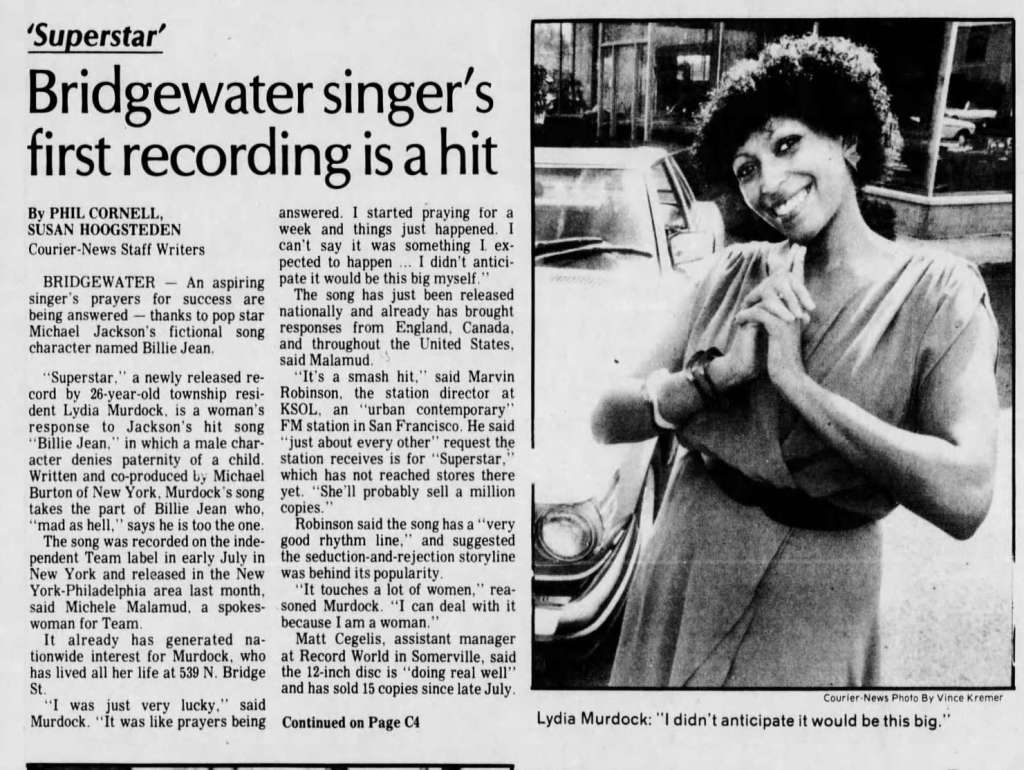
Murdock seemed astonished by how well the record had done:
I was just very lucky. It was like prayers being answered. I started praying for a week and things just happened. I can’t say it was something I expected to happen. I didn’t anticipate it would be this big myself. It touches a lot of women. I can deal with it because I am a woman.
Given those comments, it’s no surprise to learn that Murdock was one of nine children and started singing for the Macedonia Baptist Church choir in Sommerville. Singing as a career was not something she actively considered:
“I used to walk up and down the streets singing my lungs out. Singing is a part of me. I’ve just never had a chance to develop it. It’s always been in my blood.” Murdock said friends passed along a tape of her singing to the record’s producers, [Michael] Burton and Gerry Gabinelli. “They just remembered: ‘I heard a girl on a tape. Let’s get in touch with her,” Murdock explained. “I was lucky, very lucky.
My absolute favourite part of this story is this quote from a local record store manager:
Matt Cegelis, assistant manager at Record World in Somerville, said the 12-inch disc is “doing real well” and has sold 15 copies since late July.
“That’s absolutely good.” he said of the sales figure for his area. “This is Somerville, not New York.”
It seems evident that promotion in the UK was heavier than the US, always a tougher market given that records could be a hit in a single state but not go national. Murdock herself acknowledged this in her Courier-Post interview: “New York is not playing it as much as I thought it would, but I understand it’s doing well in other states.”
An interview with the Evening Standard in London on 22 September 1983 touched more directly on the Michael Jackson connection, with Murdock commenting:
I guess he’ll get in touch via his lawyers. I decided it was a smart business move to do the song. I’m single with an eight-year-old son so I was able to sing it with some conviction.
This piece also noted that Murdock worked as a “child care councillor [sic]” and was one of 168 grandchildren. Fertile family, that.
Murdock’s British label WEA shelled out for her to fly to the UK and appear on Top Of The Pops. She featured on the Thursday 13 October 1980 edition, two weeks before the song’s UK chart peak – so the appearance evidently helped.
So why was ‘Superstar’ Lydia Murdock’s only hit?
Or more bluntly: how did Murdock quickly become a one-hit wonder? Obviously, that’s always a risk when your first hit is an answer song – you give the definite impression of riding on another artist’s coat tails, and it’s harder to establish your own identity.
On top of that, it seems like Team Records, as a small label, had trouble capitalising on the initial momentum.
Case in point: the follow-up single, ‘Love On The Line’, wasn’t released by WEA until August 1984, almost a full year after ‘Superstar’ first hit the charts.
Record Mirror columnist James Hamilton noted that by the time of the official release, the track had been “a bit of a disaster on import months ago”. So dedicated fans potentially already had it. And this wasn’t just a UK problem: the Canadian release doesn’t appear to have been promoted until 1985.
Murdock’s parental commitments may well have been a factor. And it’s evident from that first interview that she wasn’t mega-hustling for a singing career – it was a happy accident.
So despite everyone’s efforts, Murdock’s chart history effectively fizzled out by 1985. But ‘Superstar’ remains a legitimate UK Top 40 hit, and the Jackson connection means it’s going to pop up as a recurring footnote.
For more highly detailed pop history, check out how Australia saved Tina Turner’s career, the truth about Big Fun and the Bee Gees or the average age of the women mentioned in ‘Wrap Her Up’.
Images: Newspapers.com/Wikimedia Commons
_(contrast).jpg#file)
Leave a Reply